Showing posts with label printing. Show all posts

Tuesday, November 30, 2010

Potatoes + linocut tools = potato printing fun!

Reading several vintage books on printing from the 1960s and earlier, I kept thinking about exploring the versatile potato when teaching some simple printing classes. As a youngster, I never got to make potato prints, because carving the designs involved sharp tools.

For my current explorations, I discovered linocut tools, which any adult or almost-adult with good hand-eye coordination will find easy to use. The surface of the potato is easy to carve and happily accepts fabric paints applied with a brayer or brush. (I use ProFab fabric paints from ProChemical & Dye. These paints can be applied over fabric with existing patterns, or with your own custom-dyed and -printed fabrics.)


I found the whole process to be delightful. Note: my designs are fairly crude. I'm sure that a skillful, patient approach could result in finer lines. Sides of the potatoes can be cut to designated shapes. Don't forget: this is a one-shot deal, one potato, one printing session. Then watch them shrivel into interesting sculptural objects, finally disposed of in a compost pile.

These images are from printed napkins or hankies from students in various teaching situations. Red star above was made using cross-sliced apple. Images below show the negative-space effect of filling a field with printed images, and with two printings from one inked potato.


Wednesday, November 10, 2010

Chicago road trip: Lillstreet Art Center + SOFA

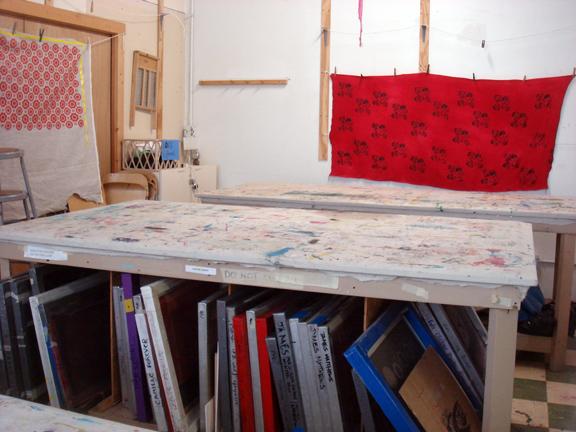
Here's an introduction to the textiles studios at Lillstreet Art Center, which is now located on Ravenswood Avenue in a former 3-story "gear shop." It's a lot like a re-purposed 1930s junior high school space. Lillstreet started out about thirty years ago, strictly as a ceramics facility on Lill Street, featuring teaching space and studios for ceramists. The move to Ravenswood coincided with an expansion to a facility with metalsmithing, lampworked glass, printmaking, painting, textiles and kids' art classes. Ceramics is still the main focus. The facility also includes a sales and exhibition area, plus First Slice, a great cafe with great food and profits going to support homeless youth meals.  I have been eagerly following Lillstreet Blog for some time, enamored with its focus on screen printing. Here you'll find pictures of this facility, introduced by head of textile area Camille Canales.

SOFA is the Sculptural Objects Fine Art Exposition, this year paired with INTUIT, the outsider art museum plus galleries. Major collector galleries exhibit at SOFA, and one has the opportunity to look at work commonly found in American Craft and other magazines. I hadn't been in several years, and the level of creativity is always astonishing. I also sat at the Surface Design Association information table, which was located in front of the Corning Glassblowing Demo booth, very informative, very impressive and great theater.

Below: the sewing workshop at Lillstreet- Camille is my guide.  
 
Camille is using pins to secure a runner to a table, in preparation for later screenprinting. I encouraged her to work as she answered questions- this was a time free of students in the dye and print studio.


Screenprinted curtains (above) and clothing (below)

It's rare to have a workshop with so many fabric screens. I was in heaven!
Below, Camille's screenprinted embroidery sampler, upon which students then practice certain embroidery stitches

above: pattern pieces. 
below: menu at the Cafe Slice. It's time now to order pies for Thanksgiving! I purchased various pieces of pie plus their squash soup to take to my overnight host and good friend, and everything was super tasty.

Above: re-arranging jewelry displays in the Lillstreet Studio gallery. 
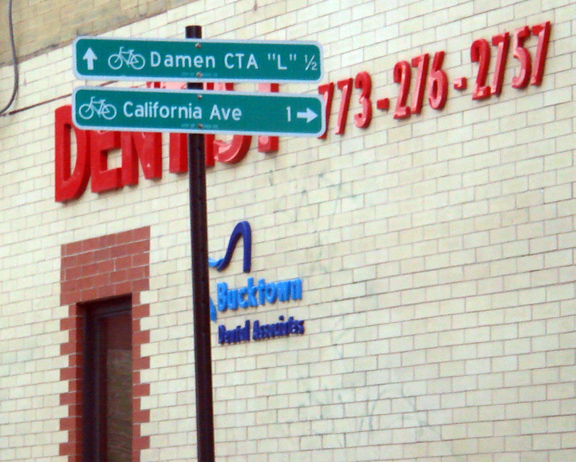
Below: I followed the many bike routes on my way back to Oak Park, through Wrigleyville.

Historic stained glass from Chicago producers, stunning examples of old and new, inside the corridor on Navy Pier. Very worth seeing.


Above: I had seen so much art at SOFA, that when I stepped outside, I was struck by the materials, color and textural contrast of this light post base. 
Below: SDA Area Representatives Linda and Darcy

Above: SDA President Candy and friend and fellow volunteer Ann attending tothe SDA informational table at SOFA, with the swatch collection
Above: a fantastic grouping of photos of Utah plus oversized ceramic sculpture by fellow Iowa City resident Gerry Eskin.  Below: stepping out towards my car, surface design is everywhere...

Saturday, October 16, 2010

Iowa SDA-SAQA-IA Artquilters Meeting

Iowa is a big state with a small population, smaller than the Twin Cities in Minnesota. Our Surface Design Association (SDA) and Studio Art Quilt Associates (SAQA) are small enough that it makes sense to pool our resources and meet together in different locations in central and eastern Iowa. I held an earlier meeting last February at my home, and this time Carol Coohey shared her home and inspiring studio with us. Nineteen women attended from the Des Moines area, Elkader, Grinnell, Guernsey, Oskaloosa, Fairfield, Cedar Rapids and Iowa City/Coralville.


Karin Gundlach explored the issue of what kind of finishing presentation is most appropriate to art quilts and fiber art in general, especially smaller pieces. She posed several questions in an online SAQA forum and received a wealth of technical responses, from mounting on a protruding cloth-covered or painted "frame," to shadow box framing, to armatures. In general the consensus was that framing or mounting of some kind helps to set these pieces off and relate them to their environment. Some participants shared pieces in which presentation was discussed.
Kris Grover shares her ideas for studio design (above), with Amanda Murphy discussing lighting (below)

Kris Grover, former University of Iowa space planner and mixed media artist then shared her Studio Design Challenge, where she converts a small 10 x 10' bedroom-type space into a functional studio. She shared drafts of this presentation, done on her laptop with many images included. This was a very interesting presentation that we could have spent more time on; Kris had many ideas for finding simple storage units at janitor supply shops and places like Cabellas. One idea was installing a simple overhead bike rack to hang three dimensional works from while they're in progress. Then
Amanda Murphy, a lighting consultant for Light Expressions and a mixed media artist working three dimensionally with concrete and felt, shared ideas and answered questions for adequate lighting.

Lastly, we had a tour of Carol Coohey's impressive studio space. Not grungy like mine, but airy and clean. She does deconstructed screen printing in the way that Kerr Grabowski does, but adds her own spin and has recently started doing regular screen printing. One look at her extensive wall of fabrics, all hanging from a cork strip rail, and one can't help but admire her grasp of this process.
Carol Coohey with her wall of deconstructed screen printed fabrics

After the meeting, participants split up, some attending Dianne Day's show at Arbor Gallery, some going to central Iowa City to visit Home Ec Workshop, Prairie Lights Books and Iowa Artisans Gallery, and some home. An interesting, enlightening time.

Wednesday, October 6, 2010

Necessities Vests!

My friend Connie Roberts is a professional artist who makes carved wooden whistle sculptures. She and I have collaborated for some time on thematic vests containing appropriate whistles. Our most popular has always been the Necessities Vest, made to order for male or female wearers, a piece that occupies a display stand during times not worn as a conversational art theater piece. Connie usually makes dozens of whistles that are visible and hidden on these vests.


 My contribution is to dye and print the cotton fabrics for vest and lining, plus pockets and trim. I designed the pockets and patterns and construct and sew the vests. When they're sewn, Connie and I get together to trouble-shoot placement, drill a few holes etc. Her whistles are by far the most entertaining part of these Vests, but what follows are photos of how the vests themselves come into being.

hand-dyed, monoprinted & screenprinted cotton fabrics using procion fiber reactive dyes


flaps, and lots of notes
the old workhorse Janome sewing machine

It helps that it's still porch weather
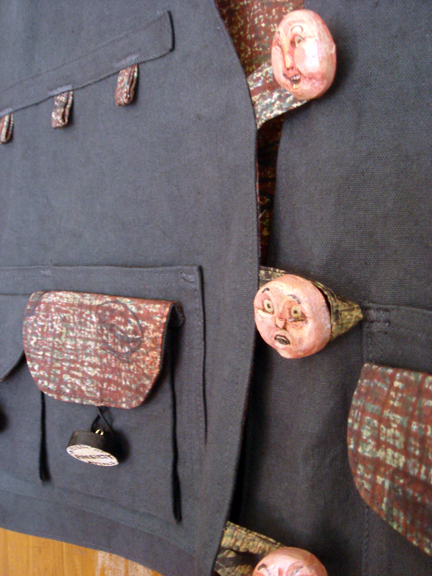
Connie's buttons are a hoot. They do not whistle.

OK, so my part is finished...
Connie and her drill. Trying to keep the sawdust off of the fabric. Placing whistles.

Whistles similar to what we have in our vests.