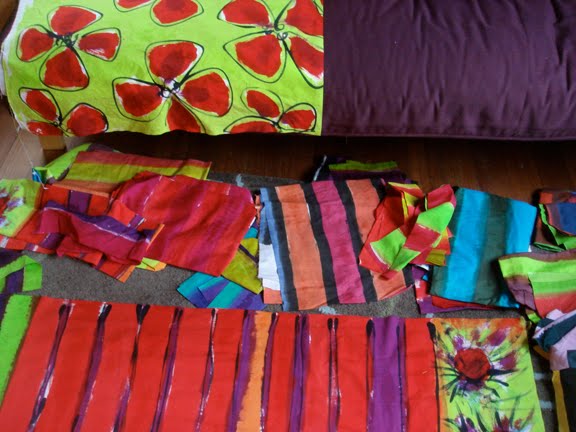
Studio tours in Emeryville
“Reinvention” Conference at San Francisco State University, March 17-19, 2010. Sponsored by the Surface Design Association (SDA) and Studio Art Quilt Associates (SAQA). This regional conference attracted primarily California artists, but also SDA and SAQA Board members, state representatives and members from adjoining and other states. A blog is a poor substitute for active participation and listening, but it is a start. Months ago, when I first read through the lineup of conference presenters, I thought,
hmm, a very academic approach. But no, this was something more. Unlike most conferences involving textile artists, this one did not have much in the way of hands-on and technique-oriented sessions. I’m sure that this aggravated some attendees. Instead, this was a textiles homecoming, a conference that took a detailed look at the handmade textile scene— now, then and future. It dealt with legacy. With long-running artist careers still fired up and ongoing. With younger, collaborative and socially-conscious work. With the interface between hand made art and museums. With the current explorations by two prominent magazines,
Fiber Arts and
American Craft.
California is the state with the most Surface Design Association members. Northern California alone has 363 members, more than some of the multi-state regions. Southern California, 160 members. Contemporary fiber art got its foothold in the Bay Area, with the now-defunct, once-thriving Fiberworks that trained so many. It still has a depth of talent and long-term career commitment unparalleled elsewhere. And we got a taste of some of this.
Day 1: The contemporary sceneKeynote speaker Marci McDade, Editor of
Fiberarts Magazine pointed out a number of innovative fiber artists in her talk
Reinvention: Transforming the Face of Fiber. McDade mentioned the trend in museums to invite artists into their collections, from which they might make works based on that experience, where both the museum piece and the contemporary interpretation would be hung side by side. Other notes: the
Design Center at Philadelphia University had a 150’ long chain link fence patterned after the traditional lace housed in their collection. Lace motifs were also used to stencil found metal in some of the Center’s garden settings. McDade also mentioned other innovative fiber projects, including
Slash: Paper under the Knife at the
Museum of Arts + Design in NYC; Anne Wilson’s
Wind/Rewind/Weave community weaving project at the
Knoxville Museum of Art. In this, Anne invited 60 weavers to do an “exquisite corpse” type of weaving, one day for each weaver. Each segment was divided by black thread. McDade also mentioned Craftweek 2.0’s
New Household Tactics, a conceptual show where a paper towel dispenser was filled with handmade papers, etc. (McDade admitted to not really understanding fashion. —since many of our artists do wearables, this seemed an unfortunate slip in what was otherwise a great lineup of information.)
Jane Przybysz, Executive Director of the
San Jose Museum of Quilts and Textiles, discussed
What Makes Fiber Art? plus the challenges of running a nonprofit museum focused on textile arts, with the “emotional logic” versus the “financial logic” of an organizational mission statement. She said, “those who identify with media rather than the art or idea are not artists.” Not all agree with this. She mentioned the provocative book,
String, Felt, Thread: The Hierarchy of Art & Craft in American Art by Elissa Auther. Przybysz noted three communities where fiber art has currency: #1 the fiber art community; #2 Post-Conceptualist artists (Rauschenberg, Eva Hess), who used fiber as “non-art” to contest the hierarchy of art and craft; and #3 the feminist art community.
Stefan Catalani of the
Bellevue Arts Museum showcased interesting examples of crossover art/textile artists. The Bellevue has no collections of its own, just organizes rotating exhibitions. Truly notable are works by Dinh Q. Le, and Ed Pien’s papercuttings, as well as Mandy Greer.
Jill D’Alessandro discussed exhibitions of historic and ethnic textiles at the
de Young Museum. All of these presenters appeared on a panel exploring the issue of what kind of work gets promoted in their institutions.
Primarily, the emphasis with all of these presenters was on exceptional work, regardless of art or craft moniker. The challenges of funding when identifying only as a craft institution where brought up. Some attendees were focused on the “Q” word- whether or not to push the term “quilt”. This of course, also brought up conversations about gender-based work. We ended our day with joint openings of exhibits in the SFS textile studios, galleries and other locations.
Day 2: ArtistsWe started with a panel of emerging artists moderated by Vic de la Rosa, of San Francisco State University.
Lacy Jane Roberts (“messy craft” rather than mastery, plastic knitting machines and academic discussions of contemporary craft and gender) and
Bren Ahearn (embroidery) discussed their own work plus other issues such as the challenges of living as gay or queer (not identifying as either female or male) artists.
Mung Lar Lam had a solid powerpoint of work called “ironings,” ironed, pleated installed works in which she appears in the installation and irons the pieces. Vic de la Rosa commented that as far as the “craft police” are concerned, it’s good to know the rules in order to break them.
The second presentation,
Can Art Make a Difference? moderated and curated by
Linda Gass focused on four exceptional artists working with environmental issues (
Linda McDonald uses humor and fine draftsmanship to focus on forestation issues),
Lea Redmond (very interesting conceptual work),
Judith Selby Lange (who makes wearables using discarded plastic bags found on a particular beach), and Gass (silk art quilts highlighting mapping and land use concerns).
We then heard from
“The Voices of Experience,” four artists with 152 combined years of studio practice between them and who are still actively engaged with their work. This fact-paced, poignant presentation inspired many of us and included work by
Michael Rohde (weaver),
Carol Westfall (mixed media) and
Consuelo Underwood (weaver and political-conceptual artist, #11 of 12 children born into a migrant family) with
Joan Schulze moderating. Any of these could have filled an hour-long segment, not just their 20 minutes allotted time.
For the closing remarks, we listened to Janet Koplos’ survey 60+ years of
American Craft magazine and how it reflected the thinking and trends of the day. Koplos is a former Acting Editor of the magazine. She showed an image of work by a younger artist named
Kathryn Pannepacker, whose murals in Philadelphia echo traditional textiles from around the world. Kathryn was sitting right next to us. And that’s how it went throughout the conference- you never knew who might have something original to contribute.
 Karen Livingstone's dye studio
This was the day where everything came together for me. Our group started at
Ana Lisa Hedstrom’s shibori studio, with work by
Yoshiko Wada and Jeanne Caciedo also on display. These three titans of the fiber arts community were generous with their time and knowledge. We were seduced by Ana Lisa’s clothing.
Yoshiko Wada explained that shibori (Japanese resist dyeing using pleating, clamping and tying, are only 150 years old. She has worked to promote the field and preserve knowledge by current Japanese shirbori masters. Then Richard Elliott, head of textiles at CCA, showed pieces incorporating digital printing.
Susan Taber Avila is creating wonderful, large-scale layered work using dyeing and machine embroidery. Her studio mate
Candace Kling comes from a historic costuming background and had manipulated trims and historic examples throughout her studio. We visited Karen Livingstone’s studio in a former corner grocery, where she does custom dyeing and once did Marian Clayden’s dyeing. And an inspiring tour of the home and gardens of Paul and
Robin Cowley, landscape architect and art quilter.
 Cameras out: the beautiful landscaping of Paul and Robin Cowley.
That night, some of us went to a fiber artist potluck way up high in the hills of Berkeley. Stunning sunset overlooking the entire Bay area. As I looked around at attendees, I was struck yet again by the sheer concentration of talent in this part of California, and the generosity and dedication of our host.
In addition, the SDA Board met before the conference, spending time on the topic of reinvention. Established in 1976, SDA is doing what any organization of similar age does- reviewing goals, strategy, mission and communications. Things are cooking up well, and we are positioning ourselves for the present and future cyber age.
What else? Trails around the hotel followed the bay, had shorebirds, and smelled of salt water. I visited with my high school friend and fellow yearbook co-editor, whom I hadn’t seen since I was 21. On my last day, I checked my bags earlier and headed to the
San Francisco Museum of Modern Art. The building alone is worth the visit, —I especially enjoyed the abstract expressionist galleries. I was surprising to see how large the Diebenkorn paintings are- I had assumed they were half the size. The collection of San Francisco-based artists was excellent quality, with fresh ideas and excellent quality of execution. I also stopped by the exhibit of textiles from Mali at the Museum of International Craft & Folk Art. I was familiar with much of what was presented but found the videos of a contemporary wedding fascinating. And then, on this stunningly beautiful day that even the locals were relishing, I headed back on my friend BART (Bay Area Rapid Transit) to the airport and flew home over snow-capped mountains and pink-tipped clouds.
 The San Francisco Museum of Modern Art
Our hotel in South San Francisco, taken from the extensive trails around the bay. My morning walks included the smell of salt water during low tide, with shore birds and blooming succulents, a far cry from the snow banks I'd left behind the week before. When I see this picture, I reminded of the California hills
Wallace Stegner describes in one of my favorite books, Angle of Repose.