Tuesday, June 21, 2011

Anni Holm & the NetWorking Project


Iowa City's celebrated Iowa Arts Festival took place June 3-5, inaugurated by a Gallery Walk at 17 downtown locations including Iowa Artisans Gallery, the gallery that I am associated with. On my rounds to check out artists at the art fair the next day, I discovered a tent with a knitting installation in progress. The red knitted labyrinth resembled a large unruly octopus and represents the work of many knitters over time. Curious, I asked artist and founder Anni Holm to tell me more about her project.


Anni, who lives in Chicago but is a native of Denmark, and fellow knitter Nyok-Mei Wong of Malaysia, started this knitting installation/performance art piece in 2006. Entitled "The NetWorking Project," it involves members of the public stopping by to knit from one of the many ends. No experience is necessary.  From her promotional materials, Anni tells us, "The NetWorking project is an attempt to physically demonstrate how a network is constructed and constantly changing. The viewers are invited to sit down and knit with the artist, and through dialogue develop their own networks beyond the boundaries of the piece." To see more images from other locations, visit The NetWorking Project's website.
Anni Holm is pictured above, at left. She told Festival organizers that about 100 knitters participated in the project over two days, not bad for a first time appearance.


Wednesday, March 9, 2011

Bumping into The Fabric Workshop in Philadelphia


In mid-February, I attended the Buyers' Market of American Craft as a buyer for Iowa Artisans Gallery.  As we prepared to leave, we discovered our flight was canceled and rescheduled for late in the day. What to do in this lovely city? Our answer was to meander, walking the streets in ways we'd been unable to do prior to this point. Next thing I knew, I was literally bumping into The Fabric Workshop and Museum, a stone's throw away from the Convention Center, where I'd attended the show for 15 years.

The Fabric Workshop! I've been reading about this venerable institution for more than twenty years. Articles have always pinpointed the Workshop's focus on screen printing, and I've been an enthusiastic screen printer for years. Naturally, I've always wanted to visit.

The Fabric Workshop was founded by Marian Stroud in 1977, both as a place to train apprentices in the field of textile design and to work with mature artists interested in fabric and unconventional materials. A Decade of Fabric and Art  celebrates the 10th Anniversary of the Center. This publication points out the 1960s connections of major artists like Alexander Calder, with the making of fiber art pieces, tapestries in Calder's case. This precedent led Stroud to invite artists like Louise Nevelson, Robert Morris, Robert Kushner, Jun Kaneko and Ned Smyth into the Workshop early on. 150 artists in all were served during the first decade.
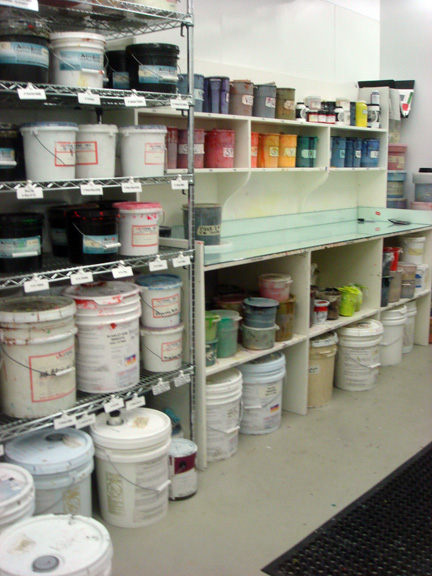
As a screen printer, I gasped with pleasure at the long tables and deep space of this printing studio.
The Fabric Workshop refined its mission in 1996, adding Museum to its name. Artists are still offered the chance to work as Artists-in-Residence with unconventional materials, not all of them fabric or textile-related. The screen printing areas serve at-risk youth in Philadelphia schools, as well as high school-, college- and postgraduate-level apprenticeships. Current artists in residence at the Workshop are profiled on the website.  The Workshop is housed on several floors of a building, with exhibition halls, screen printing production studios, administrative offices, and conservation facilities for its 5500 objects made by 400 participating artists. It also houses a museum shop where screen printed items are sold in addition to books and other goodies.

During my visit, I viewed New American Voices II, an exhibition of contemporary sculpture, installation and wall works by Robert Pruitt, Jim Drain, Jiha Moon and Bill Smith. Vastly different in concept and execution, these works will challenge anyone looking for a more traditional approach to fiber art. I was especially drawn to the work of Robert Pruitt. His website does not do his contemporary work justice, so I won't cite it here. I am not able to share images of those exhibits with you.

By becoming a contemporary art center, the Fabric Workshop has invested in its future by insuring two grant-funding streams: contemporary art, plus under-served populations. I hope that it continues to capitalize on its roots in fiber art in its appeal to artists, providing them a truly unique opportunity to make works not otherwise easily made. If you're in Philadelphia, don't do what I did and wait 15 years to visit this inspiring and provocative place.

interesting way of preserving samples
a wall display shows images from early years
Screen, test piece and drop cloth
The Fabric Workshop & Museum is located at 1214 Arch St in Philadelphia
the front window of the building showcases items fabricated from FW&M fabrics, for sale in the Museum Shop

My $12 purchase, a bag with two interesting sides, a difficult choice with so many patterns to pick from

The Fabric Workshop and Museum is located at 124 Arch Street in downtown Philadelphia. For contact and membership information, please visit this link.

Saturday, January 15, 2011

Clouds, Sky, Mountains

Flying to Santiago, Chile via Dallas, where we had an overnight flight delay due to airplane mechanical difficulties. The surprising benefit: we flew over South America during daylight- I got to actually see land over Nicaragua, Ecuador, Peru, and the spectacular Andes in waning light of day. That was pretty darn cool. Most of the time we flew over the Pacific. 9.5 hours from Dallas, almost 9 miles per minute, we flew at 38,000 feet high, breathtaking...

Nicaragua & Costa Rica, all through the airplane window

the coast of northern Peru, vast desert

cloud patterns & shadow

along the coast of Northern Chile


towards sunset, the coastal mountains of Chile


The Andes start to pop up

the giant one, Mt Aconcagua , on the Chilean border with Argentina, 22,821 feet high

Tuesday, December 28, 2010

the sketchbook project- DONE!

My new years' gift to myself: do the one studio thing I had the greatest need and drive for, starting to draw on a more regular basis. Along came The Sketchbook Project (see my October 18 post on drawing) with just enough deadline and incentive to make me finally commit. The result is not brilliant, but it's done, and it's opened my inner eye.

Here's what I wrote about my experience:
Most artists I know wish they would draw more. I started drawing in college and for two years, it was all I wanted to do. Then I took up printmaking (markmaking!) and eventually, textiles.

In my textile work, I do a lot of printing and monoprinting- I love color and music and spontaneous expression. Drawing is the act of listening to the world around you, of being an observer as opposed to a participant. Damn it, it requires a lot of patience and concentration. It is meditative.

So, now that I have time to be more of an observer, it is time to draw again, to relearn, to connect hand, eye and head. I also wanted to learn to use sumi ink wash techniques; the world is not all black and white- there’s lots of grey. The sketchbook project gave me the kick in the pants to get this rolling. Being intimidated by the first page, I decided to start in the middle. I also did my drawing in 3 separate sketchbooks each session, to loosen me up and let me try varying papers and approaches. Sometimes I included those other drawings in the Official Sketchbook.

the last of the garden tomatoes
ah, the self-portrait. An excellent way to learn to draw. At my age, it's like an exercise in geography, with mountains, valleys, rivers, desert, certainly more interesting topography, an exercise in humility rather than vanity. Oh, and those GLASSES! And no, not sad, just concentrating.

  
those birds, so hard to draw, one second and then they move again...I actually had much better examples in the sketchbook.
what's this, you ask? a 15-year old strip of newspaper used to mask wet areas when I do screenprinting. Scanned a few. All about drawing. 
 
Sketchbook cover, inside and out, printed with my screenprint of artist hands and "tabbed" with a monoprinted fabric scrap, covered with matte medium.


Fun with mirrors...

Sunday, December 5, 2010

Bird talk...

Friday during a conference call, heard a fuss on the back porch, --looked out and saw a hawk clawing the screen to get out. Tried to shoo her to the door- she got sidetracked behind a table area. Me, afraid of big talons and unknown "Hawkish" behavior. Downy feathers swirling. Called my buddy Will, the Bird Man. Came over and carefully approached the bird, clucking, a Coopers' Hawk, caught her. Held her for a bit, then thrust her to freedom. She flew to a branch on the dogwood, looked back a bit, then flew on to the high trees. Quite an experience. Meanwhile the conference call continued on speaker phone, unaware...


Tuesday, November 30, 2010

Potatoes + linocut tools = potato printing fun!

Reading several vintage books on printing from the 1960s and earlier, I kept thinking about exploring the versatile potato when teaching some simple printing classes. As a youngster, I never got to make potato prints, because carving the designs involved sharp tools.

For my current explorations, I discovered linocut tools, which any adult or almost-adult with good hand-eye coordination will find easy to use. The surface of the potato is easy to carve and happily accepts fabric paints applied with a brayer or brush. (I use ProFab fabric paints from ProChemical & Dye. These paints can be applied over fabric with existing patterns, or with your own custom-dyed and -printed fabrics.)


I found the whole process to be delightful. Note: my designs are fairly crude. I'm sure that a skillful, patient approach could result in finer lines. Sides of the potatoes can be cut to designated shapes. Don't forget: this is a one-shot deal, one potato, one printing session. Then watch them shrivel into interesting sculptural objects, finally disposed of in a compost pile.

These images are from printed napkins or hankies from students in various teaching situations. Red star above was made using cross-sliced apple. Images below show the negative-space effect of filling a field with printed images, and with two printings from one inked potato.


Friday, November 26, 2010

Line by Line series in the New York Times: hone your drawing skills!

One of the wonders of the current digital media scene is being able to mix print and video information in the same article. I am intrigued by The New York Times' Line by Line series ("about rediscovering the lost skill and singular pleasure of drawing") and can't resist posting about it here, though it's Black Friday and I have to head to Iowa Artisans Gallery for work.

Today, James McMullan's contribution centers on drawing the figure- understanding the relationship with face and hands, among other things. His contributions are today's #11 in the series: "Strategies to Get  You There" , which follows an earlier one, #10 The Chain of Energy.